Brick Types, Bonds and Layouts for Your Edinburgh Project
If you are planning brickwork, whether a garden wall, an extension or a decorative feature, the brick, bond and mortar you choose decide more than you might expect. They set how strong a wall is, how it handles water and how long it lasts. This guide from Kingsknowe Building & Landscaping walks you through the practical choices.
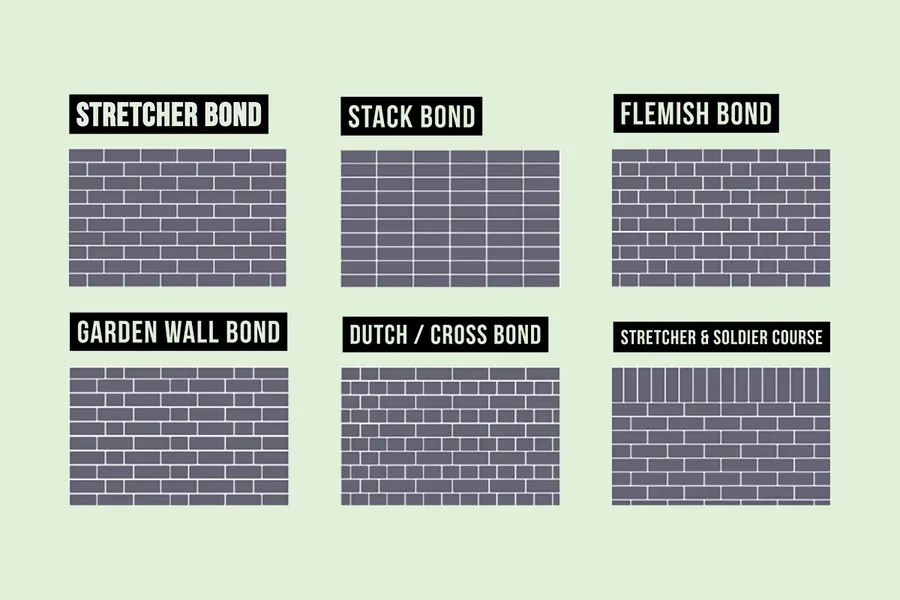
Brickwork choices matter all the more in a demanding climate of driving rain, high winds and frequent winter freeze-thaw cycles. External masonry across Edinburgh, the Lothians and Fife has to stand up to all of it, so getting the technical detail right is what keeps brickwork stable, weather-resistant and looking like it belongs.
Brick Bond Types
A brick bond is the pattern in which bricks are laid and how each course overlaps the one below. It is not purely decorative. Good bonding spreads loads evenly, ties the wall together through its thickness, and avoids long vertical joints that create weak lines up the wall. Here are the main bonds you will come across on UK projects.
Stretcher bond
- Description: The most common pattern in modern construction, laid with the long face of the brick showing.
- How it is laid: Every brick is offset by a half-brick from the course below, so no vertical joints line up. All visible bricks are stretchers.
- Typical use: The outer leaf of modern cavity walls, single-skin garden walls, and timber-frame cladding. It is economical and works well alongside ties, an inner leaf and a cavity.
English bond
- Description: Widely regarded as one of the strongest patterns for a solid wall one-brick thick.
- How it is laid: Alternating full courses of stretchers and full courses of headers, the next course turned to show the short ends.
- Typical use: Loadbearing structural walls, traditional retaining structures and any job where strength matters more than ornament. The interlock of headers and stretchers ties the wall firmly through its thickness.
Flemish bond
- Description: A classic, attractive period bond with a distinctively balanced face.
- How it is laid: Stretchers and headers alternate within every single course, with each header centred over a stretcher below so the bond carries through the wall.
- Typical use: Period property extensions, decorative front garden walls and historic restorations. Sound at one-brick thickness, though generally seen as less robust than English bond if the workmanship is poor.
Header bond
- Description: A specialist pattern showing only the short header faces of the bricks.
- How it is laid: Full courses of headers, each course offset by a half-brick, with bricks running through the wall thickness.
- Typical use: Curved brickwork, radius corners and intricate detailing rather than everyday extensions. It gives a very solid connection but is costly in labour and cutting.
English garden wall bond
- Description: A lighter-duty version of English bond that reduces the number of headers and speeds up laying.
- How it is laid: Usually three or more courses of stretchers to one course of headers, repeating up the wall.
- Typical use: Freestanding garden and boundary walls around Edinburgh, the Lothians and Fife, where you want some tying action and a traditional look without the full cost of a true English bond wall.
Flemish garden wall bond
- Description: Follows the spirit of Flemish bond but with fewer headers to reduce labour and materials.
- How it is laid: A mixed pattern of stretchers and headers, typically several stretchers to one header within the course.
- Typical use: Decorative boundary walls and feature panels in landscaping, rather than heavy structural work.
Stack bond
- Description: A modern, purely cosmetic pattern where the joints run in continuous straight lines.
- How it is laid: Bricks are placed directly on top of one another so vertical and horizontal joints align unbroken. Because the joints do not overlap, it has little structural bond strength and usually needs bed-joint reinforcement and a structural backing.
- Typical use: Internal feature walls, contemporary facades and non-loadbearing decorative panels.
Rat-trap bond
- Description: A walling configuration that places bricks on edge to leave cavities within the wall thickness.
- How it is laid: Bricks are laid on edge, alternating stretchers and headers, creating an internal cavity in a single-skin wall while keeping the faces presentable.
- Typical use: Economical traditional walling and lightweight decorative garden features. It can reduce material use and improve thermal performance when properly designed, but it is less common in standard domestic work.
A quick word on terminology: you may occasionally hear casual mention of a "Scottish bond". This is not a formally recognised national standard bond like English or Flemish bond. At most it is a loose regional description of historic practice, and it should not be relied on as a design term on its own.
Brick Types
The material and manufacture of a brick decide its compressive strength, water absorption and frost resistance. Bricks used across the east of Scotland should comply with the relevant BS EN 771 standard to ensure durability.
Clay bricks (BS EN 771-1)
Fired clay bricks are the traditional choice for most homes. Raw clay is moulded and fired at high temperature to give a durable unit, with compressive strength typically between 20 and 80 N/mm2, available in a wide range of colours and textures. Clay bricks are commonly described by function:
- Facing bricks: Chosen for appearance, colour consistency and texture on the visible face, while still meeting strength and weathering requirements. Ideal for house extensions on show.
- Common bricks: Used where appearance matters less, such as inner leaves or work that will be rendered, focusing on strength rather than looks.
- Reclaimed bricks: Salvaged from older buildings and especially useful for matching historic work, a regular concern on Edinburgh properties. Condition, frost resistance and dimensions should always be checked before use.
- Imperial bricks: Older, larger sizes used before metric standardisation. Getting the sizing right matters when tying new work into existing imperial brickwork, because it affects coursing, bond and alignment.
Concrete bricks (BS EN 771-3)
Made from aggregate concrete pressed into moulds, these units offer good freeze-thaw durability and reliable dimensional consistency. They gain strength as they cure and are used for both facing and common applications.
Calcium silicate / sand-lime bricks (BS EN 771-2)
Formed from sand and lime cured under pressure. They are known for excellent dimensional accuracy, sharp clean arrises and good sound insulation. Naturally white or cream, they can be pigmented to suit surrounding materials.
Engineering bricks
Dense clay bricks engineered for strength and low water absorption rather than appearance, classified into two grades:
- Class A: Compressive strength of 125 N/mm2 or more and water absorption under about 4.5 percent.
- Class B: Compressive strength of 75 N/mm2 or more and water absorption under about 7 percent, the usual choice for damp-proof courses and below-ground brickwork.
They suit plinths, retaining work, damp-prone areas and any situation that calls for tougher masonry.
Brick Orientations and Courses
It helps to know the vocabulary used to describe how individual bricks are placed and how horizontal rows, or courses, are named. A standard UK metric brick measures 215mm long by 102.5mm wide by 65mm high. Laid with a standard 10mm mortar joint, this gives a uniform 75mm course height (65mm plus a 10mm bed joint).
Individual orientations
- Stretcher: Laid flat with the long face showing on the wall.
- Header: Laid flat with the short end showing on the wall.
- Soldier: Stood vertically with the long narrow face showing, often above openings.
- Sailor: Stood vertically with the wide flat face showing, used for particular decorative details.
- Rowlock: Laid on edge with the header showing, common in cappings and edges.
- Shiner: Laid on edge with the wide bed face showing, mainly for decorative panels.
Common course formations
- Stretcher course: A row showing mainly stretcher faces, standard in most running work.
- Header course: A row showing mainly header faces, used to tie the wall together through its thickness.
- Soldier course: A band of vertical bricks, often above windows and doors or as a capping detail.
- Plinth course: One or more courses near ground level, sometimes in engineering bricks or with an angled profile, to shed splash and direct water away from the base. Where the work below these courses involves foundations and levels, it ties into our groundworks so the brickwork sits on a sound sub-base.
Mortar Joints
Mortar joints do more than fill the gap between bricks. The profile affects how water runs off the wall, how well the joint compacts, and how the finished face looks.
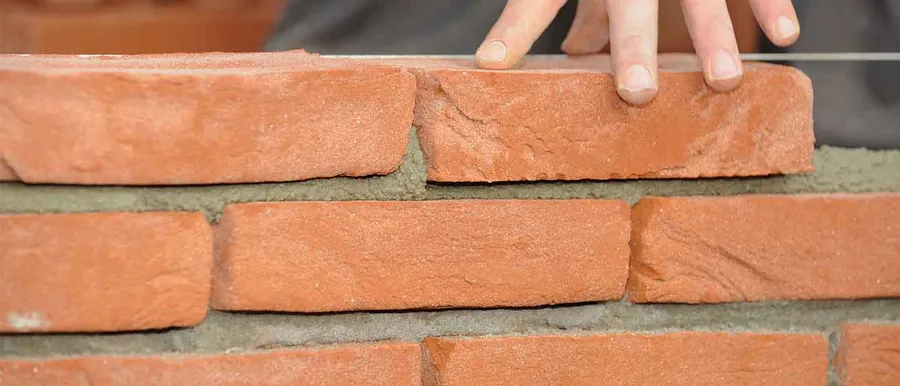
- Bucket-handle / concave joint: Tooled into a uniform rounded recess that compresses the mortar against the brick edges. When properly compacted it is widely regarded as one of the best profiles for weather resistance against driving rain.
- Weather-struck joint: Sloped down and outward from the upper brick edge to form a clean shed profile, drawing water off the front face. A practical choice in exposed locations.
- Flush joint: Finished level with the brick face for a flat, simple appearance, sometimes used where the wall will be rendered. It needs careful finishing so water does not catch along the brick edges.
- Recessed joint: Raked back from the brick arris to create shadow lines that highlight the bricks. Best avoided on highly exposed walls, where water can sit on the exposed ledges.
Joint thickness and coursing
UK brickwork usually uses joints around 10mm thick. With a typical 65mm brick and a 10mm bed joint, each course comes out at about 75mm. This matters when setting out heights to match existing work and when tying new brickwork into extensions or garden walls.
Mortar joints contribute to stability by bonding the bricks together and transferring loads. Joints that are too wide, poorly compacted or badly profiled can weaken a wall and let water in, especially when combined with a poor bond.
Decorative and Modern Techniques
Not all brickwork is purely functional. Some layouts add interest, or let light and air through, while still keeping a sense of structure.
- Corbelling: Stepping successive courses out beyond the one below to form overhangs, ledges and details. It can be structural when designed correctly, or purely decorative.
- Hit-and-miss: Leaving deliberate gaps between bricks, often in garden walls or screens, to allow airflow and views while still defining a boundary. It is useful in exposed gardens because it lets wind pass through.
- Herringbone: Bricks laid at an angle, typically 45 degrees, in a zigzag arrangement. Common in panels and infill, and a popular decorative choice in paving.
- Basket weave: Pairs of bricks laid at right angles to one another to create an interlocking, woven appearance, often in paving and sometimes in wall panels.
- Brick-on-edge: Bricks laid on edge for copings, path edges and capping details. It needs careful detailing because the edge takes weather directly.
Frequently Asked Questions
What are the most common bonds in bricklaying?
On modern domestic work around Edinburgh, the Lothians and Fife, stretcher bond is the most common pattern for the outer leaf of cavity walls, including many extensions. English bond and Flemish bond are still widely used on solid walls, garden walls and period properties where strength or appearance call for more than basic stretcher work.
What is the strongest brick laying pattern?
For a one-brick-thick solid wall, English bond is widely regarded by bricklayers and technical guides as one of the strongest patterns. Alternating full stretcher courses and full header courses ties the wall together through its thickness and avoids long vertical joints, which is why it is often chosen where structural performance matters more than ornament.
What is the most expensive brick bond?
In practice Flemish bond is often the most expensive standard layout to build. Alternating stretchers and headers within every course takes more skill and setting out, and tends to need more facing bricks to execute cleanly. The extra labour and care to get the pattern right across the whole face are the main reasons for the higher cost.
Do mortar joints affect stability?
Yes. Mortar joints help bond the bricks together and transfer loads. If joints are too wide, poorly compacted or badly profiled, the wall can be weaker and more prone to water penetration and frost damage. Well-made joints with suitable profiles, such as bucket-handle or properly struck joints, support both stability and durability in Scottish weather.
Planning Brickwork for Your Property
If you are planning new brickwork, repairs or garden walls, Kingsknowe Building & Landscaping can talk you through the practical choices for your property and tie this technical detail back to a real design. New brickwork and masonry layouts are covered under our bricklaying service, while existing wall repairs and repointing are handled separately. Where the job touches foundations, levels or extensions, the brickwork is built on a sound base rather than treated in isolation.