Storm Damage Repair in Edinburgh
When a storm hits, you do not have time to read a long sales pitch. You need things made safe quickly, then put back properly. Kingsknowe Building & Landscaping provides emergency storm damage repair, along with practical advice on how to storm-proof your garden before the next weather warning.
Emergency Storm Damage Repair Across Edinburgh and the Lothians
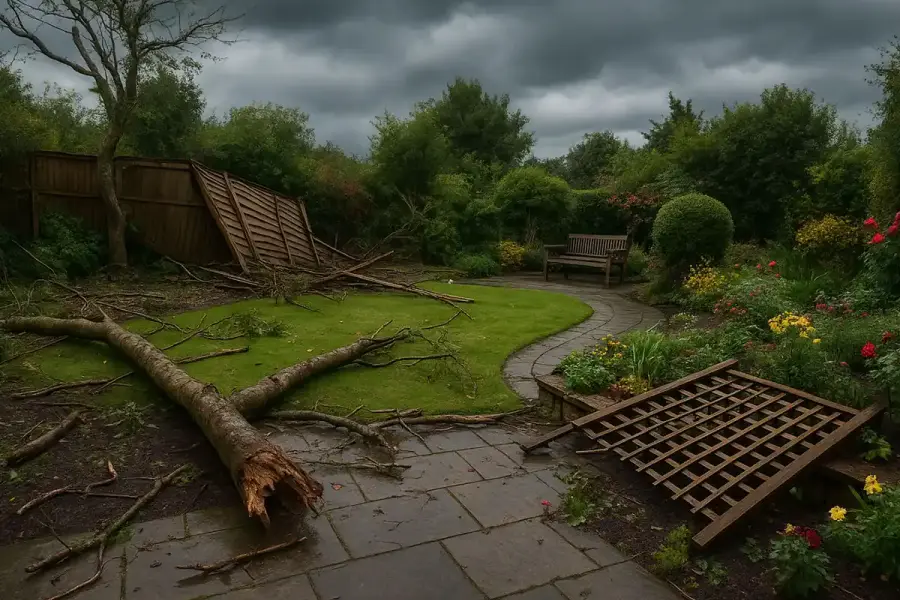
If you have storm damage right now, the first job is to make the property safe and secure. That might be loose masonry, damaged garden walls, fallen fencing, flooding in the garden, or storm-driven water getting into the house. Kingsknowe Building & Landscaping offers a fast, sensible response for homeowners dealing with the aftermath of a storm.
We carry out emergency make-safe work, temporary repairs and follow-on permanent repairs for storm-damaged external areas. We aim to attend urgent calls quickly and prioritise jobs where there is a clear safety risk or where further damage is likely if nothing is done.
If you are dealing with storm damage now, contact our team today for emergency storm damage repair across Edinburgh and the Lothians. We can talk through what has happened, advise on immediate safety steps, and arrange a visit based on how urgent the problem is.
The storm damage we put right
This page explains the storm and emergency side of things. The actual trade repairs are handled through our specialist services:
- Storm-damaged garden walls and brickwork, repaired and rebuilt under our wall repair service
- Storm-related drainage and flooding issues, investigated and put right under our groundworks service
- Storm damage to fences and gates, sorted under our fencing service
- Storm damage to paving, patios and driveways, cleared and relaid as part of the same external repairs
We do not expect you to know which service you need. This page helps you understand what is going on, and where each type of repair will be routed.
How we treat urgency
Storm damage does not all sit at the same level of seriousness. We look at it in three tiers, and we will always be honest about where your job sits. Over-promising on response times helps nobody, especially in a busy storm period.
Immediate safety risk (same-day priority). Anything with a risk of collapse, leaning or separating walls, loose chimney masonry, major cracks, electrical danger from water near wiring or consumer units, blocked exits, or parts of the property left open and insecure. Boundary walls or gates blown down next to a busy road or a drop fall into this tier too. These are treated as emergency make-safe work. If there is any risk to life or public safety, the emergency services or the utility company may need to be contacted first.
High priority (we aim to attend within 24 to 48 hours). Active leaks, failed flashings letting driving rain in, saturated ground behind a retaining wall starting to show movement, or boundaries that have broken loose and are swaying in residual winds. The job is stable enough that you are not in immediate danger, but it will get worse if left.
Standard priority (scheduled repair). Storm damage that is not actively worsening, such as a wall that has already come down into a safe area and needs clearing and rebuilding, paving lifted but not hazardous, or fencing flattened in a secure back garden. These are booked in on a planned basis and can be combined with other external work.
Why Edinburgh and the Lothians Are Storm-Exposed
Properties in and around Edinburgh do not all face the same conditions, but there are patterns worth knowing. During the autumn-to-winter Atlantic storm season, deep low-pressure systems regularly cross Scotland, bringing intense weather fronts that test residential property.
Exposed and elevated areas. Homes near the Pentland Hills, Blackford Hill and other higher ground can see noticeably higher wind speeds, as the landscape accelerates the wind over and around it. Properties on open, elevated plots often take more punishment from gusts and wind-driven rain.
Firth of Forth coastal exposure. Properties closer to the Firth of Forth face strong coastal winds combined with salt-laden driving rain and spray. Over time this accelerates wear on external materials, including older lime mortar joints and timber boundaries, and makes storm-driven rain more of an issue.
Clay soils and slow drainage. Much of Edinburgh and the Lothians sits on dense, slow-draining clay. In prolonged rain the ground saturates quickly and loses its ability to absorb water, leading to heavy surface run-off and overland flow. That water can pool against foundations, sub-floors and retaining structures, with knock-on effects for walls, fences, paving and basic access.
Urban run-off in dense districts. In denser parts of the city, hard surfaces and older drainage can struggle with sudden downpours. Gullies and small drains get overwhelmed, leading to ponding and localised flooding in low-lying gardens.
Storm season and warnings. Scotland sees more Atlantic storm activity from autumn into winter. The Met Office issues yellow, amber and red warnings to flag likely impacts. It is worth treating amber and red alerts as a prompt to check your property before the weather arrives.
Understanding these local conditions makes it easier to see why some gardens suffer repeated problems while others cope better.
How to Storm-Proof Your Garden: A Pre-Storm Checklist
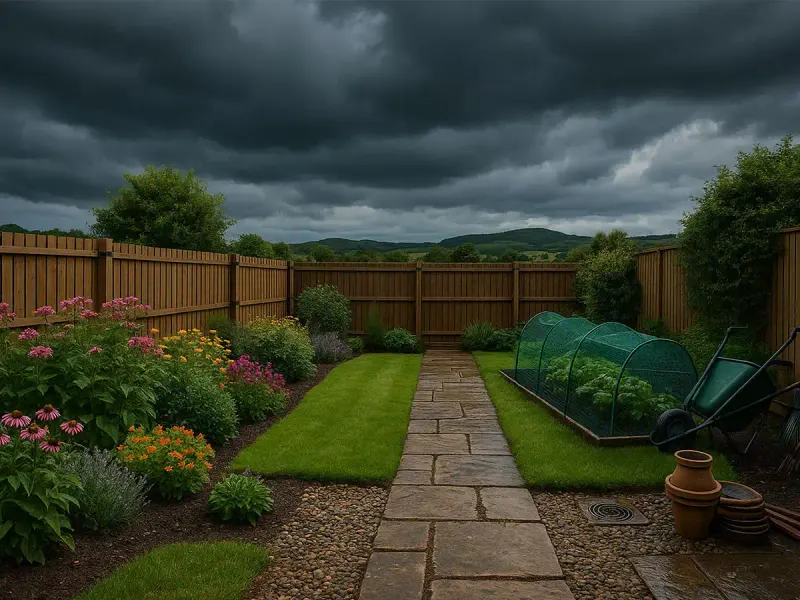
Before a named storm or high-wind warning, a few practical checks make a real difference. None of these need specialist tools, and most can be done from ground level.
- Clear gutters and downpipes. Remove leaves, moss and silt from accessible gutters and check that downpipes and gullies run freely. Blocked gutters overflow in a downpour, sending water straight into cavity walls and timber rooflines where it does not belong.
- Check garden drainage and gullies. Look at channel drains, yard gullies and simple soakaways around the house and garden. Clear surface silt so water can get away as well as the system allows.
- Secure loose garden structures. Anchor or safely store lightweight furniture, trampolines, planters, bins and tools. In high winds these become heavy projectiles that can smash glazing or chip facing brickwork. Make sure sheds are properly shut and fixings are sound.
- Arrange professional tree and branch management. If you have large trees near the house, boundary walls or overhead lines, get a qualified arborist to deal with suspect branches or top-heavy growth. This is not a DIY chainsaw job. Cutting branches near buildings or power lines always needs a trained professional.
- Check walls, fences and gates visually. From ground level, look for leaning, cracking, broken posts, loose fixings or deep mortar cracks. If something already looks marginal in calm weather, it will not improve in a storm.
- Know your access routes. Think about how you would get in and out if debris blocked your usual paths. Moving bins and loose items and keeping a secondary gate clear can help.
What to Check After a Storm: Assess and Recover
Once the worst of the wind and rain has passed, start with safety, not with repair.
- Carry out a ground-level safety survey. Walk the garden and external areas from ground level only. Do not climb on roofs or ladders after a storm. Look up for loose slates, broken ridge tiles or hanging branches, and check boundary walls and fences for new movement, tilting or open cracks. Keep away from anything that looks like it might still move.
- Photograph the damage. Before moving any debris, take clear, date-stamped photographs, including wide shots of the full layout and close-ups of cracks, broken posts or watermarks. Photograph any temporary steps you take, too.
- Notify your insurer. Contact your home insurer as soon as practical to report the storm and the visible damage. Provide your photographs and the time the damage occurred, and follow their guidance on how they want repairs managed.
- Control moisture once ingress is stopped. When the source of water has been controlled, focus on drying affected areas safely. Open suitable windows and use fans or dehumidifiers as advised, and move possessions away from damp patches. Do not use electrical appliances in flooded or wet areas until a qualified electrician has confirmed it is safe.
Getting the garden usable again is usually a staged job: make it safe first, then deal with standing water and debris, then plan the repair.
What Is Safe to Do Yourself, and What Needs a Professional
Storms tend to bring out a lot of well-meant DIY. Some of it is fine. Some is not.
Tasks a careful homeowner can normally handle
- Ground-level visual checks of the house, garden and boundaries
- Moving light debris off paths and lawns, away from hazards
- Clearing small amounts of surface muck from ground-level gullies and drain grates
- Moving furniture, planters and possessions out of wet areas
- Keeping children and pets away from damaged parts of the garden
If at any point you are unsure, stop and treat the area as unsafe until a professional has looked at it.
Tasks that should go straight to a contractor, utility company or the emergency services
- Roof access and roofing work of any kind
- Working at height, including tall ladders, scaffolds and tree work. Falls from height are a leading cause of serious injury, and a storm-damaged roof is never worth the risk
- Dealing with structural cracks, leaning walls or partial collapses. Propping up heavy brick or stone with makeshift timber is dangerous, as collapsing masonry is extremely heavy
- Chainsaw work near buildings, boundaries or anywhere close to overhead cables
- Anything involving electricity, power lines, consumer units or wiring
- Suspected gas leaks or damage to gas pipework
Never touch a cable or line that has fallen to the ground. Where power lines or gas are involved, contact the network operator or emergency services first.
Kingsknowe Building & Landscaping can take on the external building and landscaping work once the site is safe and any utility or emergency issues have been dealt with. Storm-damaged walls and brickwork are rebuilt, drainage and flooding issues are put right, and fences, gates and boundary timber are repaired or replaced. Damaged hard surfaces are relaid through our patio and driveway and paving services.
Get Your Property Storm-Ready or Repaired
Storms are stressful, especially when they hit overnight or while you are away from home. The aim is to get things safe first, then put them back in a way that copes better with the next round of weather.
If you need help after storm damage, or you want a sensible storm-readiness assessment for your garden and external areas, get in touch with our team. We work directly with homeowners across Edinburgh, the Lothians and Fife to make external spaces safer, more resilient and easier to live with in a Scottish climate.